Your ads are getting clicks. Visitors browse your products. Some even join your email list. But hardly anyone buys.
If that describes your store, the problem is probably not your website. If you already have trust badges, clear policies, a founder story, pricing transparency, and some social proof, the site itself is likely not what is holding you back.
The real issue is relational. Visitors from a curated marketplace or loyalty program arrive with implicit trust already established by that platform. First-time visitors from a paid ad arrive with none. For any purchase above roughly $50 to $100, especially in categories like electronics where purchases are considered and returns are a concern, that trust gap is the primary obstacle.
This article covers what actually bridges that gap without a deep review base or a budget for influencer seeding.
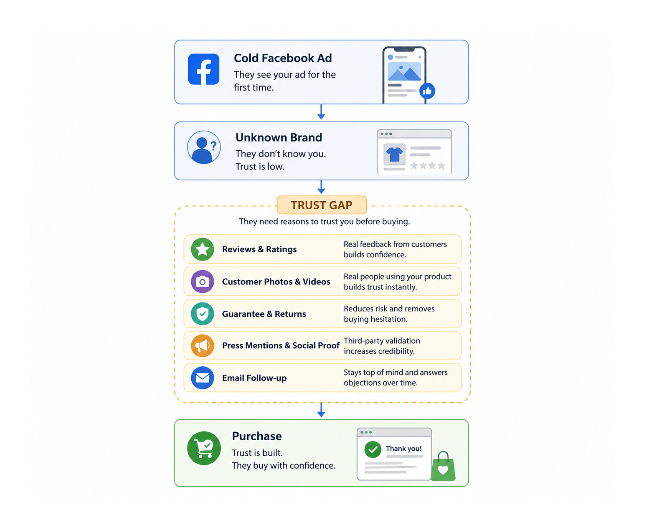
Why Cold Traffic Converts Differently
A customer who finds your product through a niche community, a loyalty program, or a curated marketplace has had a third-party vouch for your existence before they ever saw your product. That implicit vouching collapses the trust-building process significantly.
A first-time visitor who sees your ad on a social platform has received no such vouching. They are evaluating your brand entirely from scratch, often in under 60 seconds.
To make this concrete: imagine you are selling a $180 mechanical keyboard. Someone clicks your Facebook ad and lands on your product page. They have never heard of your brand. Within the first few seconds, questions are already forming. Is this company real? Will they actually ship? What if it arrives broken? Can I return it easily? For a low-cost impulse purchase those questions might not matter. For a $180 considered purchase, none of them being answered quickly is enough to lose the sale.
Social proof and risk reduction are the two mechanisms that answer those questions. Most of the other trust signals on a product page — badges, icons, policy links in the footer — are secondary until the core concern is resolved.
What the Product Page Needs for First-Time Visitors
For paid ad traffic, a product page works differently than for warm traffic. Warm visitors arrive already partially sold. New visitors are evaluating whether they trust the brand enough to consider the product at all.
The most important elements for a first-time visitor, in roughly the order they need to encounter them:
Proof this is real. Customer photos, reviews with full names visible, third-party mentions. Not professional product shots alone. The first question paid ad traffic asks is "Is this a product real people actually bought?" not "Does this product look good?"
Real humans behind the brand. A founder photo, a short note about who makes the product and why, or even a photo of your workspace or packing process does more trust work than most design elements. People trust people more than logos. One photo of you packing an order does more for a first-time visitor than a row of security badges.
Risk reduction, stated explicitly. Not just a policy page linked in the footer. The return window, what is covered, and who to contact if something goes wrong, visible near the buy button. "30-day returns, no questions asked, contact us at [email]" stated plainly above or below Add to Cart reduces the primary psychological barrier at the moment of commitment.
A specific reason to buy from this brand. For first-time visitors this matters more than for warm traffic. What does this product do that a larger brand's version does not? Generic copy does not differentiate. Specific copy that speaks to the actual buying situation does.
Page speed. A paid ad visitor has lower patience than a warm one. If the page takes more than two to three seconds to load, a significant portion leave before the trust-building process even begins. See the guide on why your Shopify store is loading slowly if page speed is a concern.
Getting More Reviews From Existing Customers
The most common problem is not that customers are unhappy. It is that happy customers do not think to leave reviews unless the process is effortless.
If customers are emailing you to say they love the product but not leaving reviews when requested, the review request itself may be the problem. A few things that make the difference:
Link directly to the review form. Any navigation required reduces completion dramatically. If you use Judge.me, Loox, Okendo, or any other review app, they provide a direct link to a pre-populated review form. Use that exact link in your email, not your homepage or a general reviews page.
Send the request at the right time. The request should arrive a few days after estimated delivery, not immediately after purchase. Send it when the customer has had time to use the product and is still in the honeymoon period with it.
Make it feel personal. An email that reads like it came from a real person gets opened and acted on more often. Reference the specific product they bought. Write in a voice that feels direct rather than automated.
Ask directly and simply. "Would you mind leaving a quick review? It takes under a minute and really helps us." Remove anything from the email that competes with the review action.
Follow up once. A single follow-up to non-reviewers a week later meaningfully increases review volume. More than one follow-up causes unsubscribes without proportionally more reviews.
Reward reviewers. A discount code sent after someone leaves a review increases review volume and thanks the customer at the same time. The guide on sending a discount to a specific customer in Shopify covers how to automate this with Flow so it runs without manual work each time.
For customers who email you directly with positive feedback, reply and ask them personally in the same thread. A response to a compliment that includes "Would you be willing to share that as a review? Here is the link:" has a high conversion rate because the customer is already engaged and warm.
Building Social Proof With Few Customers
Every brand with a deep review base started with none. Before you have dozens of reviews, you can still build visible credibility with what you have.
Ask early customers for phone photos of the product in use rather than formal reviews. An unpolished customer photo of your product on someone's desk or in their hands is more credible to a first-time visitor than a professional product shot. Ask permission to use positive emails as testimonials and display those on the product page or a dedicated social proof section.
When you display the reviews you do have, de-emphasise the count and surface the content. Four detailed customer reviews displayed thoughtfully reads as more credible than four short generic reviews with a review count badge in large font. "4 reviews" creates doubt. A detailed paragraph from a real customer with a name and a photo does not.
Specific testimonials convert. "Great product, highly recommend" is invisible. A testimonial that names a specific use case, mentions a specific feature, or describes a specific outcome is worth displaying. Generic ones are not.
Importing and Repurposing Existing Social Proof
If you have reviews on other platforms, product mentions on YouTube, blog features, or customer-created content, surface them on your Shopify store.
Most review apps allow you to import external reviews. Junip supports importing CSV files of reviews. If you have reviews on Amazon, Etsy, or elsewhere, export them and import them to your product pages immediately.
Blog features and YouTube videos are especially valuable for higher-priced items. Pull a direct quote from any blog feature and display it prominently on the product page. If YouTube videos exist, embed them or link them in a dedicated press section. Third-party media is one of the highest-trust signals available because it is inherently independent. A real person or publication chose to cover your product without being paid.
Using Guarantees as a Conversion Tool
A guarantee is not just a legal protection. It is a conversion mechanism that directly addresses purchase risk.
For a considered purchase, the buyer's biggest fear is often not "what if the product is bad" but "what if I spend this money and regret it." A strong guarantee converts some of that fear into a calculable risk: "I can spend this money and if I regret it, I can reverse it."
The guarantee needs to be easy to find and easy to understand for it to function this way. A 30-day return policy buried in a footer link does not reduce purchase anxiety at the moment of decision. The same policy stated on the product page near the buy button does.
"If you are not completely satisfied, email us and we will make it right" is more trust-building than "see our returns policy." It transfers the risk more completely to the seller and reads as a commitment rather than a disclaimer.
The Role of Email in Converting Paid Traffic Over Time
Not every new visitor will convert on the first visit. For higher-priced considered purchases, many buyers take days or weeks between first exposure and purchase. If you only measure first-visit conversion, you undercount the real value of the traffic.
A visitor who did not buy on first visit but signed up for your email list is not a failed conversion. They are a warm lead on a longer decision timeline.
The email sequence that runs after signup is what does the trust-building work over time. For first-time visitors from paid ads, the sequence should focus less on promotional offers and more on substantive content: why the product exists, how it compares to alternatives, real customer results, and what happens if they are not satisfied. This answers the questions a considered-purchase buyer asks before committing, at the pace they want to go through it.
A popup that captures emails from visitors who do not buy turns some of those first visits into a longer conversation. Even a two to five percent email capture rate on paid traffic gives you a pathway to convert them through a slower, trust-building sequence rather than losing them permanently.
What Does Not Work
A few things commonly recommended that are less effective for stores with small or emerging review bases:
Popups that push for the sale immediately. A cold visitor on their first visit does not need a discount popup within five seconds. It interrupts the trust evaluation before they have had time to assess the product. Exit intent triggers work better because they catch the visitor at the point of leaving rather than interrupting them mid-browse.
Review widgets with low counts. A product page that prominently shows "4 reviews" can create more doubt than one that de-emphasises the count and surfaces the content instead.
Generic testimonials. "Great product, highly recommend" adds nothing. Only display testimonials specific enough to be credible.
Where to Start
If you only have a few hours to work on this, prioritise in this order:
- Move your return policy and guarantee near the Add to Cart button on your product page
- Add a founder photo or behind-the-scenes image that shows a real person behind the brand
- Rewrite your review request email with a direct link to the review form and a cleaner ask
- Import any external reviews you have to your Shopify product pages
- Set up an email popup with an exit intent trigger and a follow-up sequence focused on trust rather than promotions
The Honest Timeline
Cold paid traffic will convert at lower rates than warm traffic until your social proof base reaches a threshold where it becomes self-reinforcing. That timeline is slower than most founders want, and there is no shortcut that eliminates it.
What accelerates it is volume of genuinely happy customers plus a friction-free review request at the right moment. The goal in the current stage is not to match warm traffic conversion rates. It is to convert at a rate that is profitable enough to keep growing the volume of real customers and real reviews.
Trust is not built through badges or clever copy. It is earned through every interaction a customer has with your brand. You do not need hundreds of reviews to start building it. You need a consistent process that turns each satisfied customer into proof for the next one.
The checkout experience also matters for first-time buyers in ways that go beyond design. If a new visitor reaches checkout and encounters confusion, unexpected costs, or friction of any kind, the trust built through the product page is undone. The guide on common reasons your Shopify checkout rate is low covers the specific friction points that most affect new buyer conversion.