You are setting up a product that customers buy by measurement. A fabric customer wants 1.5 meters, someone buying tea wants 250 grams, and a customer buying liquid wants 2.5 liters.
The problem appears when you set up the product in Shopify. The quantity box accepts 1, 2, or 3, but not 1.5 or 2.5. You then have to work out how to charge the right price and reduce the right amount from your inventory.
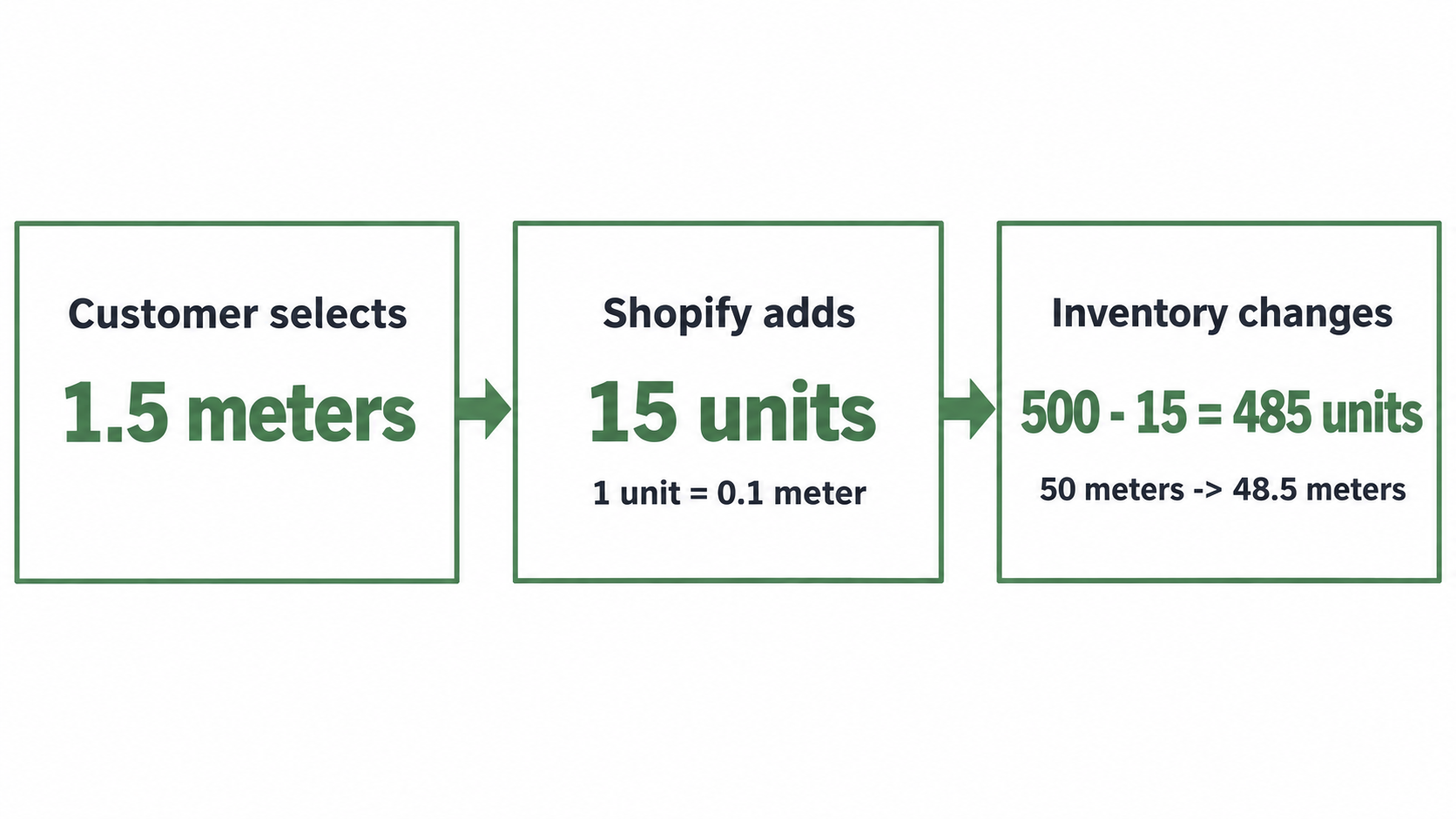
Shopify does not support decimal quantities directly. The practical setup is to make one Shopify unit represent the smallest amount you sell. A customer who wants 1.5 meters can then order 15 units, while Shopify keeps the price, order, and inventory accurate.
Use the Smallest Unit You Sell
Suppose you sell fabric at $20 per meter and customers can order it in 0.1-meter increments. Set the product up like this:
| Shopify unit | Real amount | Price |
|---|---|---|
| 1 unit | 0.1 meter | $2 |
| 5 units | 0.5 meter | $10 |
| 15 units | 1.5 meters | $30 |
| 20 units | 2 meters | $40 |
The product price is $2 because one Shopify unit equals 0.1 meter. A customer who wants 1.5 meters adds 15 units to the cart, and Shopify calculates the order as $30.
Add the unit to the product title or description so the quantity field makes sense:
This fabric is sold in 0.1-meter units. Add 15 units for 1.5 meters.
The same setup works for weight, length, and volume:
| Product | Shopify unit | Customer order |
|---|---|---|
| Tea | 1 gram | 250 units = 250 grams |
| Cable | 1 centimeter | 125 units = 1.25 meters |
| Liquid | 0.1 liter | 25 units = 2.5 liters |
Choose a base unit that is small enough for the amounts customers order, but do not use a smaller unit than you need. Selling fabric in millimeters, for example, makes every order and inventory count unnecessarily large.
Set Inventory in the Same Unit
Inventory must use the same base unit as the product price. If you have 50 meters of fabric and one unit equals 0.1 meter, enter 500 units in Shopify.
When a customer buys 1.5 meters, Shopify removes 15 units. The inventory then shows 485 units, which represents 48.5 meters remaining.
This keeps Shopify inventory accurate, but the admin shows the base-unit number rather than the measurement your customer uses. Keep a note of the conversion in the product description, and use the same unit when receiving stock, making manual adjustments, or creating purchase orders.
If you want to work with the real measurement in a separate stock sheet, you can sync your Shopify inventory to Google Sheets on a schedule. Use the same conversion there so the sheet shows both the Shopify quantity and the real amount.
If you order raw materials from suppliers, Shopify's purchase order and incoming inventory system helps you track stock that is on the way using the same base unit.
If you sell several package sizes from one bulk stock pool, read about tracking bulk inventory by weight in Shopify. That setup is different from simply letting customers order a decimal amount.
When Variants Are Better
Use variants when customers choose from a short list of fixed amounts and you do not need arbitrary quantities.
For example, create variants for 0.5 meter, 1 meter, and 1.5 meters. Each variant has its own price, and the customer leaves the quantity at one.
This is easy for customers to understand, but each variant has its own inventory count. A 0.5-meter variant and a 1-meter variant do not automatically draw from one shared 50-meter stock pool. Use the base-unit method when all sizes need to reduce the same stock.
Check the Cart and Checkout
Place a test order before publishing the product. For the fabric example, add 15 units to the cart and check three things:
- The cart total is
$30. - The order shows a quantity of 15.
- Inventory decreases by 15 units.
The order shows Shopify's whole-number quantity. If customers need to see 1.5 meters on the order or receipt, include the measurement in the product title, variant name, or a line-item property. That label explains the amount without asking Shopify to store a decimal quantity.
If customers must type 1.5 directly, need a live price calculation, or sell through Shopify POS using a scale, use an app built for selling by weight or measurement. Check how the app handles inventory, order quantities, receipts, and multiple locations before installing it.