The compare at price is the crossed-out original price that appears next to a lower sale price on your product page. When it is set correctly, customers immediately see the original value and the discount you are offering.
It is one of the simplest conversion signals you can add to a product page, but many merchants struggle to find the field or understand why it is not showing up after they fill it in.
What the Compare at Price Actually Does
When you enter a compare at price on a product, Shopify shows it crossed out alongside the current selling price. Most themes also display a percentage or amount saved label automatically. This visual cue tells the customer they are getting a deal without you needing to write anything in the product description.
The compare at price has no effect on actual pricing. It does not create a discount code, change what the customer pays, or interact with Shopify's discount system. It is purely a display field. What the customer pays is always whatever is in the Price field.
How to Add a Compare at Price for a Simple Product
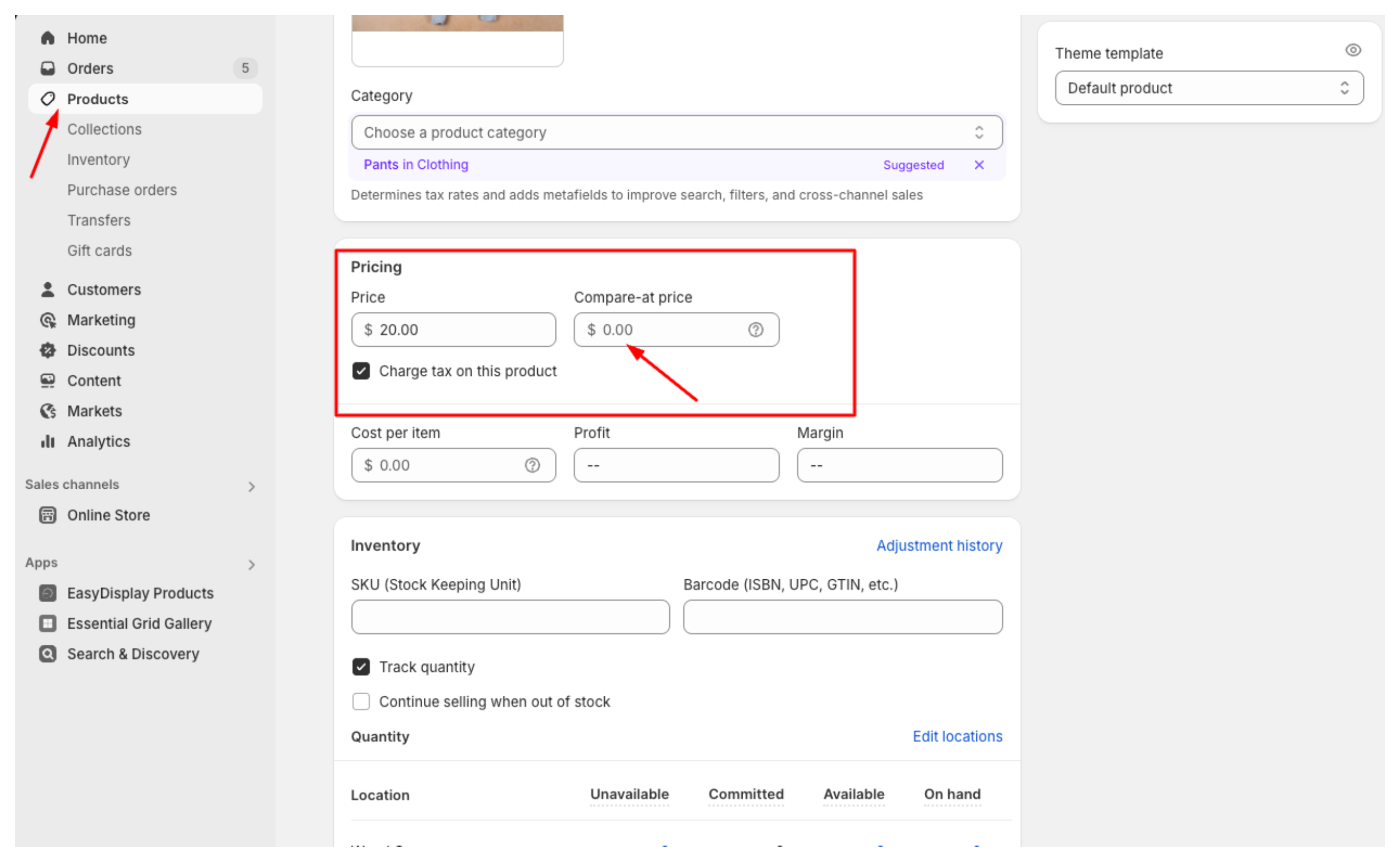
Open your Shopify admin. Click Products in the left sidebar and find the product you want to update.
Scroll down to the Pricing section. You will see two fields: Price and Compare at price. The Price field is where your current selling price lives. The Compare at price field is where you enter the original or higher price.
Enter the original price in Compare at price. Make sure it is higher than the current Price, otherwise Shopify will not display it. Click Save.
That is all it takes for a simple product with no variants. Open the product page on your storefront and you should see the compare at price displayed as a strikethrough beside the sale price.
How to Add a Compare at Price for Products with Variants
If your product has variants such as different sizes, colours, or materials, the compare at price needs to be set on each variant individually. Setting it on the main product level does not carry through to variants automatically.
Scroll down to the Variants section on the product page. Click on the first variant to open its detail panel. Look for the Pricing section inside the variant. You will see the same Price and Compare at price fields.
Enter the original price in the Compare at price field for that variant. Save, then repeat for every other variant.
If your variants are all at the same price point, this is still a manual process. Shopify does not have a bulk field for compare at price across variants. You need to open each variant and fill it in separately.
What to Do If the Compare at Price Is Not Showing
If you have entered the compare at price and saved, but it is still not appearing on the product page, the most common reason is a theme limitation.
Some themes only display the compare at price if it meets certain conditions. The most frequent issue is that the theme checks whether the compare at price is greater than the current price. If you accidentally set both to the same value, it will not display.
The second thing to check is whether your theme supports the compare at price display at all. Most Shopify themes do, but heavily customised themes or older themes sometimes have this part of the template removed or hidden. Open your theme editor and check the product template to see if the compare at price is included in the price display section.
If you are on Dawn or any other current Shopify default theme, the compare at price should display without any additional setup.
Using Compare at Price Across Many Products
If you want to set a compare at price on many products at once, Shopify supports this through bulk editing. Go to your product list, select the products you want to update, and choose Edit products from the action menu. This opens a bulk edit table where you can add the Compare at price column and fill in values across multiple products at once.
For very large catalogs, you can also update compare at prices via a CSV import. Export your products, add the Compare At Price column to the spreadsheet, fill in the values, and reimport. If you are already syncing your Shopify inventory to Google Sheets, you can manage compare at price values there as part of your regular inventory workflow and then import the updated CSV back into Shopify.
A Note on Using Compare at Price Honestly
Shopify does not enforce what you enter in the compare at price field. You can set any number. But showing an inflated or fictitious original price can create legal risk in some countries, particularly in the EU and UK where consumer protection laws require that advertised sale prices reflect genuine previous pricing.
If you are running a genuine promotion or a limited-time markdown, the compare at price is a powerful tool. If you are building a recurring deals or sale section on your store, the guide on setting up a weekly deals section in Shopify covers the complete workflow including how compare at price fits alongside tags, automated collections, and optional automatic discounts.
It works especially well when paired with scheduled product publishing — you can set the compare at price in advance, schedule when the product goes live at the sale price, and schedule when it comes back down, all without being at your computer when the sale starts or ends.
For straightforward promotions, this is one of the simplest and most effective display improvements you can make to a product page.