You sell on Etsy, eBay, or Amazon. Orders come in. The marketplace works. But your Shopify store has been live for months and has produced almost nothing.
You have posted on social media, put business cards in orders, and told people your website exists. Still nothing. You are paying a monthly Shopify fee and starting to wonder if it is worth it.
This situation is extremely common, especially in the first year. There are specific, structural reasons why it happens, and understanding them tells you exactly what to fix.
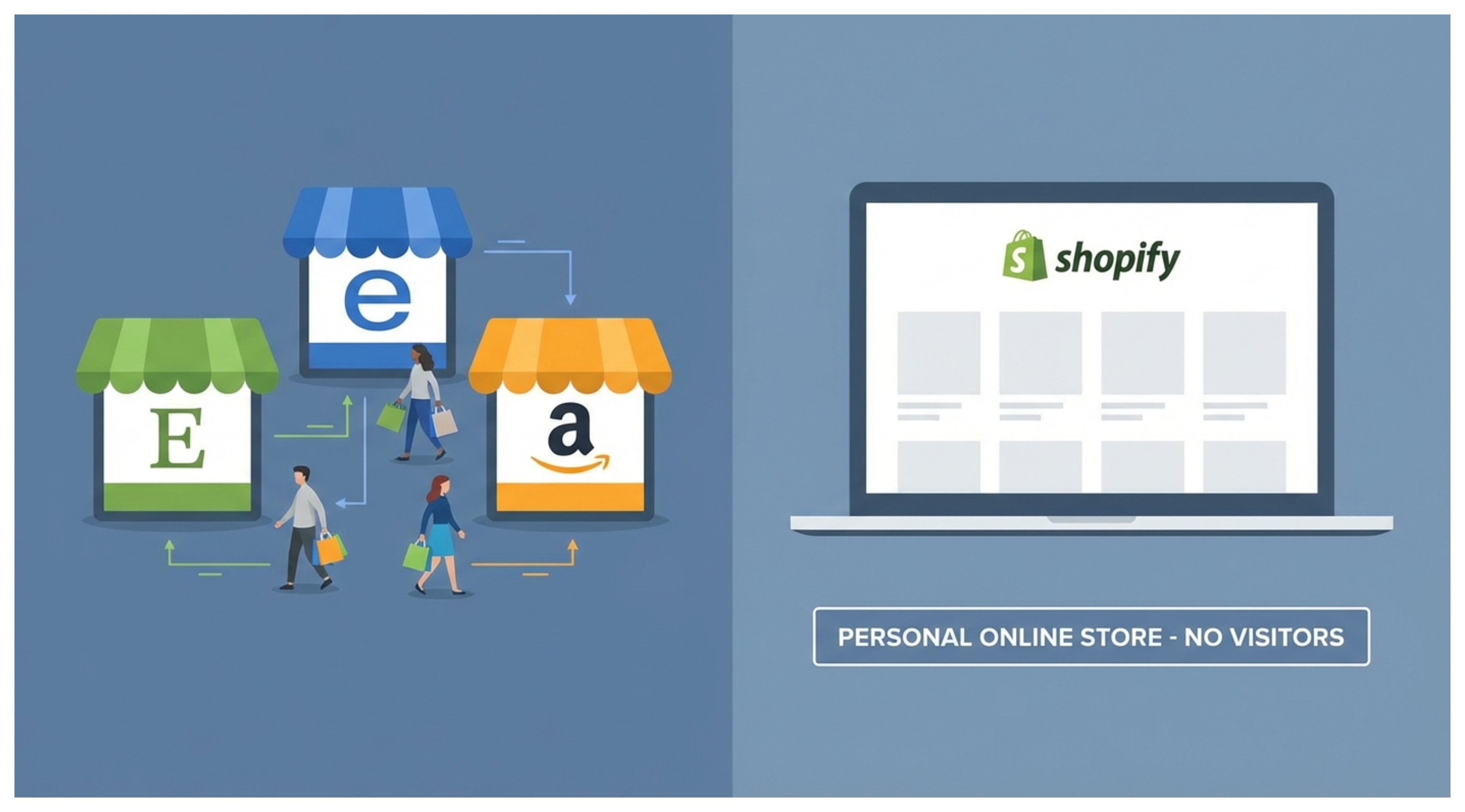
The Core Problem: Marketplaces Give You Customers, Shopify Does Not
Etsy and eBay are search engines with millions of active buyers. When you list a product there, people who are already looking to buy can find it. The marketplace does the hard work of acquiring the customer. You pay for that with fees.
Shopify is a platform, not a marketplace. It gives you a storefront, payment processing, and order management. It does not send you any customers. Traffic generation is entirely your responsibility.
This is the fundamental difference that catches most people off guard. Moving a product from Etsy to Shopify does not bring the Etsy demand with it. The customers who buy on Etsy are searching on Etsy. They are not searching for your domain name.
Reason 1: Your Traffic Is Too Low to Expect Any Sales
Shopify stores convert at roughly 1 to 3 percent on average, though this varies widely by product category, price point, and how well the store is set up.
At 1 percent conversion, you need 100 visitors to get 1 sale. At 2 percent, 50 visitors per sale.
If your store is getting 20 to 40 visits per week from social media posts and the occasional business card, zero sales is statistically normal. It does not mean anything is broken. It means you have not solved the traffic problem yet.
Before drawing conclusions about your Shopify store's conversion rate, you need enough traffic to make the data meaningful. That typically means at least several hundred sessions over a few weeks.
Check your Shopify analytics under Reports, then Sessions. If your traffic is very low, the first problem to solve is not conversion rate, it is traffic volume.
Reason 2: You Have Given Buyers No Reason to Switch
A customer who bought from you on Etsy has zero incentive to buy from your website next time unless you give them one. From their perspective:
They already know the checkout flow on Etsy
Etsy has buyer protection they trust
Your Shopify store is unfamiliar
The price is the same
Expecting loyalty to your brand to outweigh the familiarity of the marketplace is unrealistic early on. Most customers follow the path of least resistance, which is buying where they already feel comfortable.
Another angle worth considering is creating urgency through limited-time releases. If you run a product drop, a weekend-only item, or a pre-order that closes on a specific date, it gives marketplace buyers a reason to act on your site specifically. The guide on running a timed product drop on Shopify covers the full workflow for setting this up without any manual oversight. If you have an exclusive product or bundle only available on your website, that creates a reason to visit.
A discount code specific to your website is one of the most effective tools here. Print it on your packaging inserts. Something like "Save 10% on your next order at [yoursite].com with code DIRECT10" gives customers a concrete financial reason to try the direct channel. If you want to go a step further, tiered discounts that reward higher spend make buying direct feel even more worthwhile.
Reason 3: Your Store Does Not Feel as Safe as a Marketplace
Etsy and eBay both carry the trust of the platform. When a customer buys on Etsy, they know they can open a dispute if something goes wrong. Etsy is responsible. That safety net reduces hesitation significantly.
On your Shopify store, the customer is trusting you directly. If they have never heard of your brand outside of a marketplace, that trust does not automatically transfer.
Look at your store from the perspective of a first-time visitor who has never bought from you before. Ask yourself:
Is there a clear refund and return policy?
Is there a way to contact you if something goes wrong?
Are there visible customer reviews?
Does the store look professional and complete?
Does it load quickly? A store that takes 6 or 7 seconds to show products feels unfinished and untrustworthy even if everything else is right. The article on why Shopify stores load slowly covers how to diagnose and fix this if speed is a problem.
Missing any of these increases hesitation. A policy page that is hard to find, no reviews, a contact page with just a form and no email address, or a store that looks unfinished all raise doubt in the visitor's mind.
Reviews are particularly important on Shopify because the platform does not carry the social proof that marketplaces do. Import your Etsy reviews using an app like Junip, Judge.me, or Loox, or ask past marketplace customers to leave a review on your website.
If you are also running paid ads and finding that cold traffic is not converting despite good ad metrics, the article on building trust with cold traffic when you have few reviews covers what actually bridges the trust gap for first-time visitors from paid channels.
Reason 4: Social Media Traffic Converts Poorly Without Warm Intent
Posting on TikTok or Instagram is a brand awareness activity, not a sales activity, especially when your following is small.
Someone who sees your product on TikTok while scrolling is not in buying mode. They may like the video, maybe follow you, and rarely visit your website. Of the tiny number who do visit, most are still not in buying mode. This is a very cold audience with very low purchase intent.
Compare this to a marketplace customer. They opened Etsy or eBay specifically to shop. They searched for your product category. They are in buying mode. The conversion rate from that traffic is inherently much higher.
This does not mean social media is useless. It can build an audience over time. But if your current traffic source is almost entirely organic social posts, expecting Shopify sales from it requires either a large audience or a viral moment. Neither is reliable.
What Actually Drives Traffic to a Shopify Store
There are three sources that work reliably for Shopify traffic:
Paid advertising. Meta ads and Google Shopping ads let you put your product in front of people who are actively looking to buy. This costs money, requires learning, and takes time to become profitable, but it is the most direct path to consistent traffic. Most successful independent Shopify stores use paid ads.
Organic search (SEO). If your product solves a specific problem or fits a niche that people search for, ranking in Google for relevant terms can bring consistent free traffic. This takes months to build but compounds over time. Writing product descriptions and collection pages that target specific search queries is the starting point.
Email list. Customers who have bought from you once and opted into emails are the warmest possible audience. If you have Etsy customers, directing them to sign up for your email list (through packaging inserts, a website incentive, or a follow-up message within Etsy's allowed messaging) gives you a direct line to re-engage them outside the marketplace. A simple popup that captures emails with a discount offer is one of the easiest ways to start building that list.
The Right Way to Think About Your Shopify Store Right Now
Your Shopify store does not need to replace Etsy immediately. The goal in the early stage is to:
Build it properly so it is credible when people do land on it — that means reviews visible, policies clear, and checkout friction minimised
Collect email addresses from marketplace customers over time
Test one traffic source to learn what works for your product
Give buyers a clear reason to use the direct channel
Shopify's real long-term value is that you own the customer relationship. Etsy can change its algorithm, raise fees, or suspend accounts. A customer who buys directly from you and subscribes to your email list is yours. That is what makes the investment worthwhile, not the immediate sales volume.
Most stores that succeed on Shopify took 6 to 18 months before the direct channel became meaningful. The ones that gave up early usually stopped because they expected marketplace-level traffic from a channel that does not provide it.