The advice to spend 30 minutes a day on SEO is well-intentioned but misleading for most small store owners. It implies that SEO is a daily practice that requires constant attention, which eventually leads to burnout.
The truth is that most SEO work is front-loaded. You do the setup once, you maintain it occasionally, and the results compound over time without requiring daily input.
Most small stores do not fail at SEO because they do too little. They fail because they spread effort across too many low impact activities, such as checking rankings daily, publishing blog posts weekly with no strategy, and tweaking things that do not matter. Here is a more honest picture of what actually needs doing and how often.
The Setup Phase Is Heavy, the Maintenance Phase Is Not
When you first start taking SEO seriously, there is a lot to do. Auditing your product pages, writing proper meta titles and descriptions, fixing collection pages, sorting out image alt text, submitting your sitemap. This phase feels overwhelming because you are doing months of neglected work all at once.
Once that foundation is in place, the ongoing work is much lighter. A small Shopify store with 20 to 200 products and steady but low traffic typically needs two to five hours of SEO-related work per month to maintain and improve its position once the basics are in place. Not 30 minutes a day, which adds up to fifteen hours a month.
What Actually Needs Regular Attention
Check Google Search Console once a week. This takes ten minutes. Look at whether impressions and clicks are trending up or down. Check for any new crawl errors or coverage issues. You are not doing deep analysis every week, just making sure nothing has broken.
Add new products with proper SEO as you go. Every new product should have a real meta title, a meta description, and image alt text from the start. This is not extra work if it becomes part of your upload process. It takes three to five minutes per product.
Write one piece of content per month if you are doing content SEO. One well-researched article that answers a specific question your customers search for is worth more than four generic posts. If monthly feels like too much, one every six weeks is still progress. Quality and relevance matter more than frequency.
Do a proper SEO review every quarter. This is your deeper session. Go through Search Console properly, look at which pages have dropped in rankings, find pages that are getting impressions but few clicks and improve their titles or descriptions, check for broken links, and identify one or two pages worth improving. This quarterly session might take two to three hours and replaces the need for constant daily attention.
Your Monthly SEO Routine (Simple Version)
If you want to translate this into a repeatable habit:
10 minutes per week, check Search Console for errors or drops. 1 to 2 hours per month, improve one or two existing pages based on what Search Console is telling you. 1 to 2 hours per month, write or plan one article targeting a specific customer question. Ongoing, add SEO properly to every new product before it goes live.
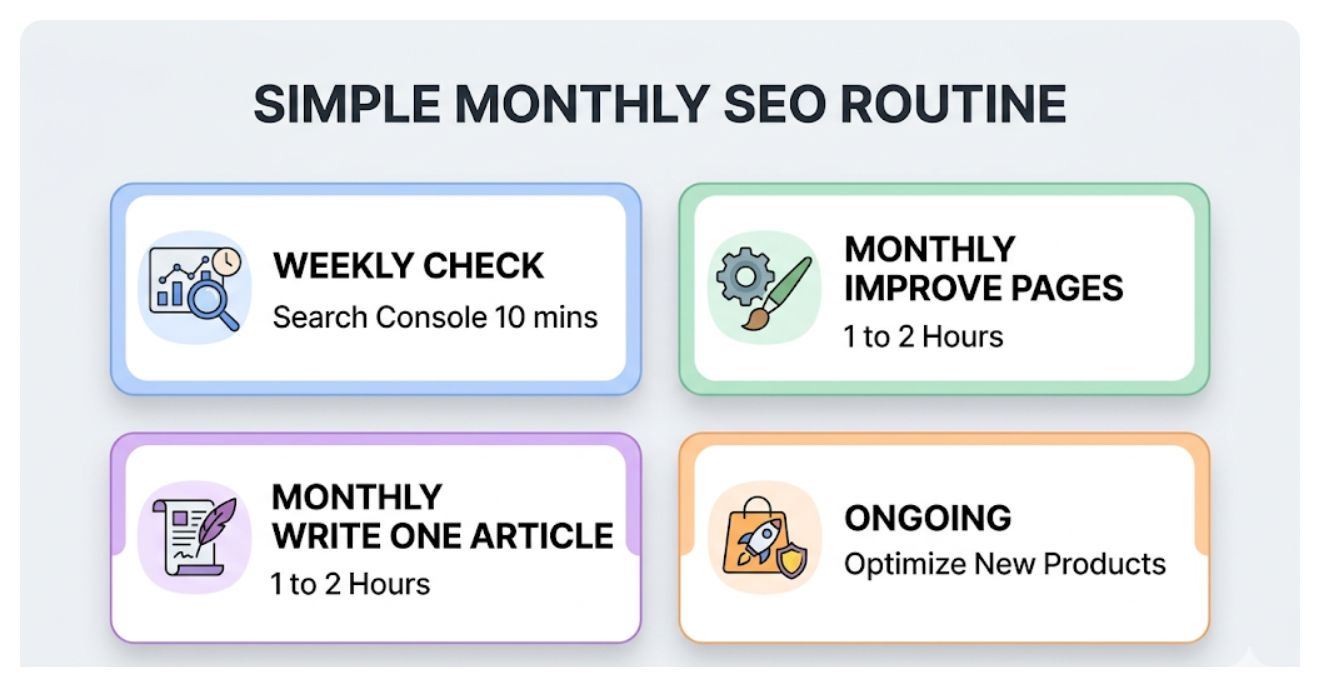
That is it. Everything else is optional until you have these four habits running consistently.
What You Can Safely Deprioritise
You do not need to publish a blog every week. Weekly blogging is a strategy for businesses with dedicated writers. For a solo store owner, one good article a month is a realistic and effective pace.
Upselling and cross-selling are conversion optimisation, not SEO. They affect what happens after someone lands on your store, not whether they find it in the first place. Important for revenue, but a separate problem. Do not bundle it into your SEO workload.
Video is optional. Video can help SEO indirectly if it drives links and engagement, but it is not a core requirement for a product-based Shopify store. If it is adding to your burnout, drop it.
Daily keyword rank tracking is not necessary. Rankings fluctuate constantly for normal reasons. Checking monthly is enough for most stores.
When Results Actually Show Up
This is the part most guides skip. SEO changes take time to show impact, which is exactly why daily work is unnecessary. Results simply do not move at a daily pace.
Most content pieces take four to eight weeks to start getting impressions in Google, and a few months to bring consistent traffic. Technical changes like fixing meta titles often show up faster, sometimes within two to four weeks once Google recrawls those pages. But the pattern is the same: you make a change, you wait, you check Search Console a month later.
Understanding this timeline is what makes it possible to relax your pace without feeling like you are falling behind. You are not falling behind. The work you did last month is still being evaluated.
The Right Way to Think About It
SEO for a small Shopify store is more like tending a garden than running a factory. You plant things, you check in occasionally, you pull out weeds when you see them, and you add new things periodically.
The merchants who build consistent organic traffic treat SEO like a background process. It gets attention in focused sessions rather than constant monitoring.
If you are not sure whether your foundation is actually complete, start with how to get organic traffic to your Shopify store before optimising your schedule. If the foundation is done and traffic is still flat, why your Shopify store is stuck at low traffic covers the less obvious reasons worth investigating next.
If your foundation is done, the highest return action is simple: write one genuinely useful article targeting a real customer question, publish it, and check back in a month.