Getting stuck at 50 to 60 visits per day after months of SEO work is frustrating and very common. The merchants who hit this plateau have usually done the basics, such as product page titles, some internal linking, and maybe a few backlinks. But traffic has not moved.
The reason is almost always one of a handful of specific problems. Here is how to diagnose which one applies to your store.
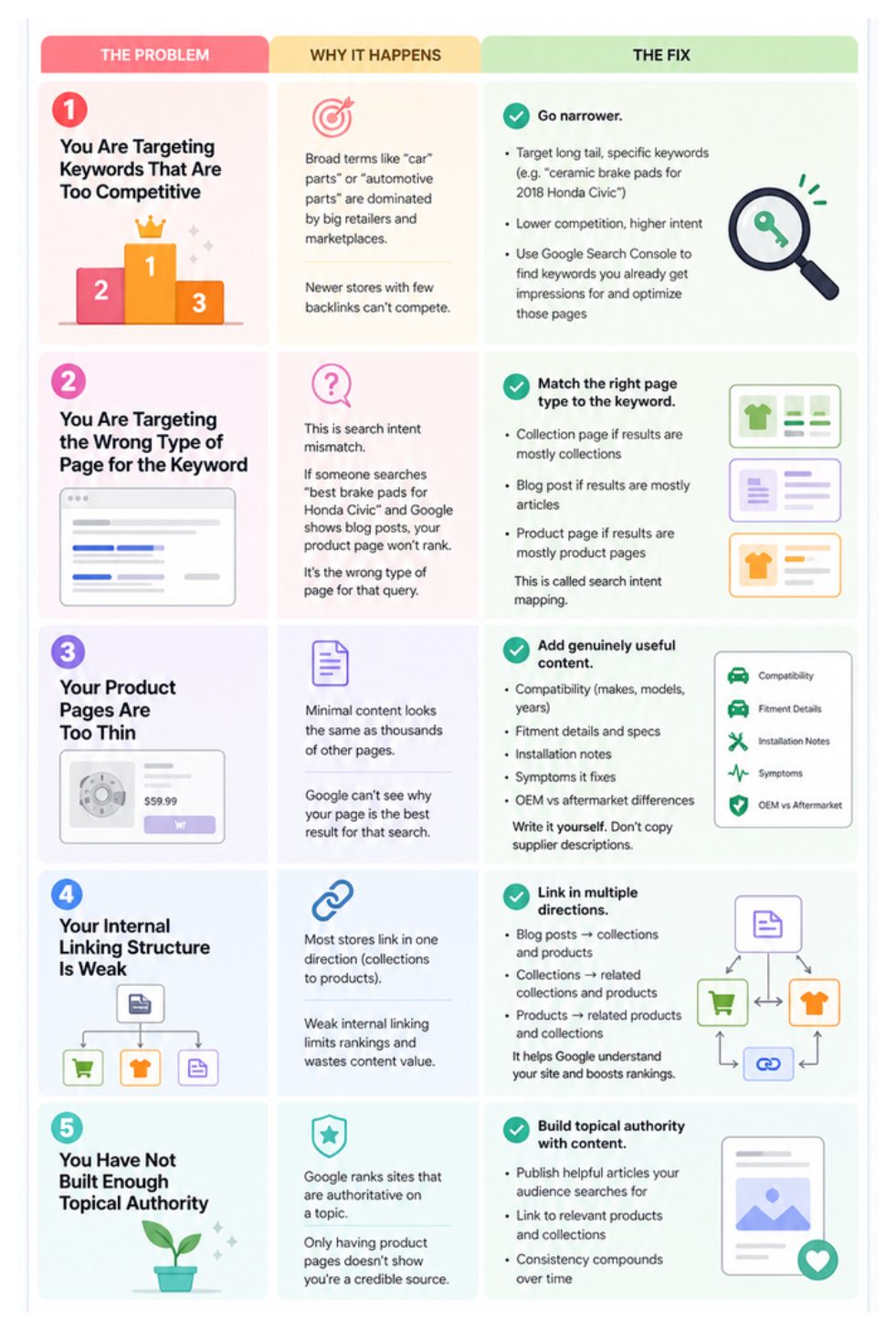
You Are Targeting Keywords That Are Too Competitive
This is the most common reason SEO efforts stall. You optimise your pages for terms like "car parts" or "automotive parts" and nothing happens. These terms have been dominated by large retailers and marketplaces for years. A newer store with few backlinks cannot compete for them regardless of how well the page is optimised.
The fix is to go narrower. Instead of targeting "brake pads," target "ceramic brake pads for 2018 Honda Civic." Instead of "car filters," target "oil filter for Ford F-150 5.0 V8."
These longer, more specific terms have lower search volume individually but also much lower competition. A smaller store can actually rank for them. And the people searching are further along in the buying process, so they know exactly what they need and convert at a higher rate.
Go through Google Search Console and look at the queries your store is already getting impressions for. These are searches where Google has decided your pages are at least somewhat relevant. Optimise specifically for those terms rather than chasing broader ones.
You Are Targeting the Wrong Type of Page for the Keyword
This is one of the most common plateau causes and one of the least talked about. It is called search intent mismatch.
Here is how it happens. You target “best brake pads for Honda Civic” on a product page. But when someone searches that phrase, Google shows comparison guides and review articles, not product grids. Google has determined the intent behind that search is informational, not transactional. Your product page will not rank for it no matter how well optimised it is, because it is the wrong type of page for that query.
Before targeting any keyword, search it in Google and look at what type of page appears in the results. If results are mostly collection or category pages, the keyword belongs on a collection page. If results are mostly articles or guides, the keyword belongs in your blog. If results are mostly individual product pages, it belongs on a product page.
Matching the right page type to the keyword is called search intent mapping, and getting this wrong is one of the fastest ways to do a lot of SEO work for no result.
Your Product Pages Are Too Thin
Shopify product pages often have minimal content, such as a product title, a short description, and a price. From Google’s perspective, these pages look almost identical to thousands of other product pages for the same part.
For an automotive parts store specifically, there is a lot of genuinely useful information you can add that competitors often skip. Compatibility information, such as which makes, models, and years the part fits, is exactly the kind of specific detail that helps a page rank for long tail searches. Fitment details, installation notes, what symptoms indicate this part is needed, and how it differs between OEM and aftermarket options are all things a buyer wants to know.
Write this content yourself rather than copying supplier descriptions. If multiple stores use the same manufacturer text, none of them rank particularly well for it.
Your Internal Linking Structure Is Weak
Most stores link in one direction, from collections to products. But internal linking is one of the strongest free ranking levers available, especially for lower authority sites, and the most effective links go in multiple directions.
Blog posts should link to relevant collection pages and products. Related collections should link to each other. Product pages should link to related products and the collections they belong to. These contextual links tell Google which pages are important, help it understand the relationship between your content, and distribute ranking authority across your site more effectively.
If your blog posts are standalone articles with no links back to your products or collections, you are missing the conversion and SEO value they could be passing. A blog post about “how to know when your brake pads need replacing” that links directly to your brake pad collection is doing double duty, building topical authority and directing both readers and Google toward a page you want to rank.
You Have Not Built Enough Topical Authority Yet
Google does not just rank individual pages. It evaluates how authoritative a site is on a given topic. A site with useful articles about automotive maintenance, brake systems, and suspension components signals to Google that it is a credible source in that niche. A site with only product pages does not.
Informational content is a significant opportunity for stores in specialist niches. Articles like “how to know when your brake pads need replacing,” “OEM vs aftermarket parts, what is the difference,” or “how to check your car’s suspension” attract people who are not ready to buy yet but are in your audience. These articles build topical authority and can link directly to the relevant product or collection pages.
This is not quick work but it compounds. The stores that break through the low-traffic plateau consistently have more content than their competitors, not just better-optimised product pages.
Backlinks Take Longer Than Most People Expect
A new backlink can take weeks or months to be crawled, evaluated, and reflected in rankings. That is before you even see whether it moves anything.
For small stores specifically, the most practical link sources are often closer than you think. If you stock products from suppliers or manufacturers, ask to be listed as a stockist or distributor on their website. These are relevant, authoritative links that are easier to get than cold outreach.
Niche forums and communities in your product space are often open to genuine contributors. Getting listed in relevant industry directories takes an afternoon and builds a base of consistent signals. If you have existing business relationships, such as other shops, local organisations, or complementary businesses, those are also worth asking.
Generic outreach to blogs gets a very low response rate. Start with relationships and relevance before moving to cold outreach.
What to Do Right Now
Open Google Search Console and check three things. First, look at the queries report and find searches where you already have impressions but few clicks. These are the pages closest to ranking and the best candidates for improvement.
Second, check the Coverage report for indexing errors or unexpected numbers of indexed pages. Third, review Core Web Vitals to make sure your pages load fast enough on mobile.
Then pick your five most important collection pages and make sure each has a genuine introductory paragraph, an H1 that matches the real topic, and links to relevant product pages and related collections.
For a full breakdown of how to build out your collection page strategy to rank for more keywords, how to use collection pages to rank for more keywords on Shopify covers it in detail. For the broader SEO foundation, how to get organic traffic to your Shopify store covers the full priority order.