If you have looked at a competitor in a keyword tool and seen them ranking for fifty keywords, the instinct is to wonder how to fit all fifty into your pages. The answer is not to do that. You cannot stuff fifty keywords into a meta title and Google explicitly warns against trying.
What your competitors are doing is simpler and more effective. They are not ranking one page for fifty keywords. They have built twenty pages that each rank for two or three keywords.
Think of your site like a grid. Rows are keywords, columns are pages. You do not stack keywords into one column. You expand the grid.
Why Collection Pages Are What Rank for Commercial Keywords
Google matches search intent to page type. For commercial keywords where someone is ready to buy, Google almost always ranks collection or category pages, not individual products or blog posts. When someone searches “running shoes” or “gold necklaces,” the results are pages showing multiple products rather than a single product listing.
This means:
Commercial buying keywords belong on collection pages.
Specific single-product queries belong on product pages.
Informational questions belong in your blog.
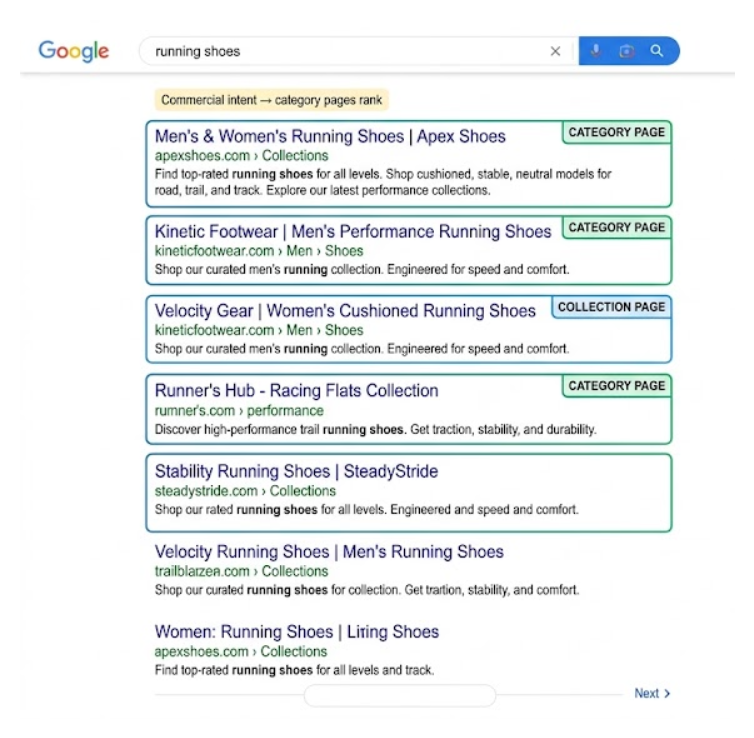
Targeting a commercial keyword with the wrong page type is one of the most common reasons SEO work produces no results. Before you build or optimise any page, search your target keyword in Google and look at what type of page is already ranking. Match that page type.
A Concrete Example
If you sell mugs, here is how the grid expands:
"Ceramic coffee mugs" — main collection page
URL/collections/ceramic-coffee-mugs
Title "Ceramic Coffee Mugs — Handmade and Dishwasher Safe"
Description focused on materials and everyday use"Handmade ceramic mugs" — separate collection page
URL/collections/handmade-ceramic-mugs
Title "Handmade Ceramic Mugs — Unique Designs"
Description focused on craftsmanship and individuality"Mug gift sets" — separate collection page
URL/collections/mug-gift-sets
Title "Mug Gift Sets — Ceramic Mugs for Gifting"
Description focused on occasions and packaging
Three collection pages, three distinct keywords, each page targeting one primary term with natural related terms appearing in the description. None of them compete with each other because the intent is different enough.
One Keyword Per Collection Page: The Full Framework
Each collection page should align across six elements:
Primary keyword What the page is built around. One term, chosen based on search volume and realistic competition for your store's authority level.
URL handle
Short, matching the keyword. /collections/ceramic-coffee-mugs not /collections/collection-1 or /collections/shop-our-mugs.
Title tag Primary keyword plus one differentiator, under 60 characters. Use the formula: Primary keyword + differentiator. For example: "Ceramic Coffee Mugs — Handmade and Dishwasher Safe" "Trail Running Shoes — Waterproof and Lightweight"
H1 The collection title in Shopify. Should match or closely mirror the title tag. Google reads H1 as a strong signal for what the page is about.
Intro description 150 to 300 words written for a person, not a search engine. Explains what the collection contains, who it is for, and what makes it worth choosing. Related keywords appear naturally without being forced.
Internal links pointing to it Other pages on your site linking to this collection using anchor text that matches the keyword. A blog post about "how to choose a ceramic mug" that links to your ceramic coffee mugs collection using that phrase as the anchor text tells Google exactly what that collection page is about and passes authority toward it.
How to Build Your Internal Linking Structure
Internal linking is the most overlooked part of collection page strategy. Every collection page you build needs other pages pointing to it.
Link from blog posts to collections. A post about "how to care for ceramic mugs" should link to your ceramic coffee mugs collection naturally within the content. A post about "what to look for in trail running shoes" should link to your trail running shoes collection.
Link between related collections. Your ceramic coffee mugs collection can reference your mug gift sets collection at the end of its description. These contextual links help Google understand how your collections relate to each other and distribute ranking authority across your site.
Use descriptive anchor text. "Shop our ceramic coffee mugs" is better than "click here." The anchor text is a keyword signal. Use it.
How Many Collections Do You Actually Need
Look at your competitor's site structure, not just their keyword list. A store ranking for fifty keywords probably has fifteen to twenty-five collection pages, each targeting two to four related terms.
Here is a simple process for building your own collection map:
Export your keyword list from whatever tool you use
Group keywords by topic and intent — keywords describing the same type of product belong together
Assign one primary keyword to each group
Map each group to an existing collection page or identify it as a gap where a new collection is needed
Start creating or optimising collections for the five groups with the clearest commercial intent and the most relevant products in your range
Shopify's automated collections make this fast. You can create a new collection in minutes by setting conditions based on tags or product type, and Shopify will populate it automatically as you add matching products.
Watch Out for Thin Collections
Creating many collections only works if each one has enough products to feel like a real destination. A collection with one or two products tells Google and visitors that this is not a meaningful category.
Aim for at least five to ten products per collection. If you cannot reach that, consider whether the keyword warrants its own page or whether it could be covered as a secondary term within a broader collection.
Thin collections also tend to have thin descriptions, which reduces the page’s ability to rank. Every collection needs a proper introductory paragraph, not a sentence or two, but a genuine description that explains what is in the collection and why someone should buy from it.
Building It Out Over Time
Start with five collection pages targeting your clearest commercial keywords. Get those right, including proper URL, title, description, and internal links pointing to them. Then expand.
Every new collection page is not just a page. It is a new entry point into your store from search. Stores that grow organic traffic consistently do not optimise harder on the pages they already have. They expand the grid intelligently, one well-built collection at a time.
For the broader SEO foundation these collections sit within, how to get organic traffic to your Shopify store covers the full priority order. If your collections are built and traffic is still flat, why your Shopify store is stuck at low traffic despite doing SEO covers the less obvious reasons including search intent mismatch and internal linking gaps.